The condition
Bardet-Biedl syndrome is a ciliopathy. It is a rare genetic disorder that affects several body systems at once: vision, kidneys, cognition, hormones. It also causes hyperphagia, an insatiable hunger that is neurological rather than behavioural and cannot be reasoned away.
It is rare enough that most GPs will never see a case. Symptoms arrive one at a time and years apart, so each one gets treated as its own separate problem.
By the time a family gets a diagnosis, most have already been told they are fine. Or that they are exaggerating. Parents get told the problem is parenting.
The system wasn’t built for them. They know it. Our job was to write down what that actually costs.
Discovery
Rhythm Pharmaceuticals makes precision medicines for rare neuroendocrine diseases. They understood the clinical picture in detail. Nobody had written down the lived one.
So there was no product at the end of this. No screens, no roadmap, no feature list. One question instead: what does a life with BBS actually look like, for the person, the family and the clinician.
I would take that brief again. Research usually gets asked to arrive pre-shaped like a solution, which quietly decides the answer before the fieldwork starts.
Research
The project ran six months end to end. We interviewed 24 families representing 29 people with BBS, alongside five healthcare professionals: GPs and specialists who see this group regularly. The fieldwork covered the UK, France and Germany, with one participant from Austria.
Normal sampling logic does not survive a population this small. You cannot recruit twenty strangers for a moderated session when there are not twenty strangers to recruit.
Surveys were out too. This cohort has been surveyed to exhaustion by a system that asks a great deal of them and gives little back.
So we listened instead. Long, structured conversations about ordinary life rather than about products. What the diagnostic years had cost, financially and otherwise. What a good day looks like, and what a bad one does.
One journey map
I ran the fieldwork and designed the artefact, so the person drawing the lanes had sat in the interviews. On a map this dense that matters. Every cell is a decision about what to leave out.
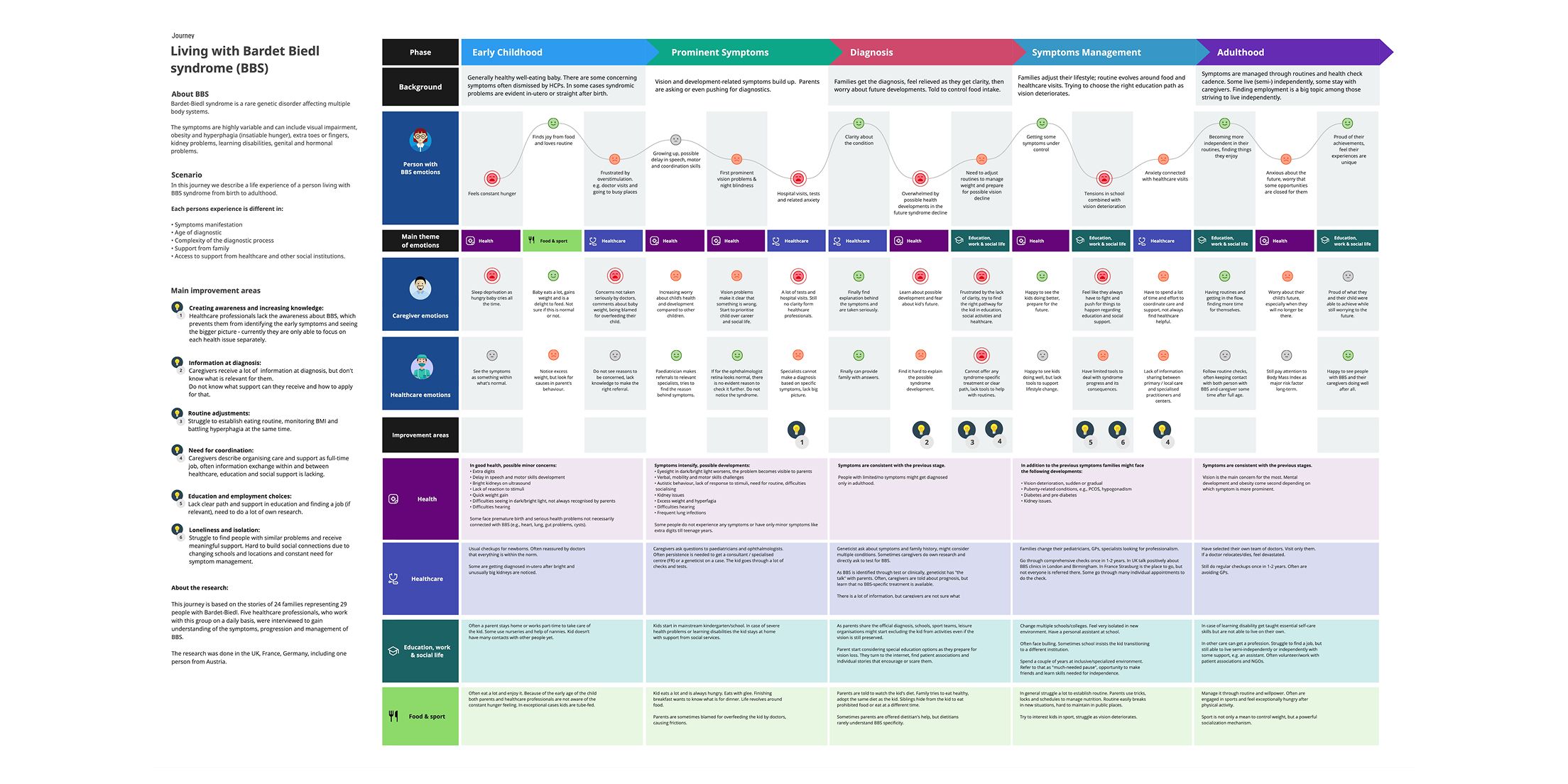
Everything went into one artefact. Five phases run across the top: early childhood, prominent symptoms, diagnosis, symptom management, adulthood. Everything below a phase is what that phase actually contains.
Three lanes carry emotion, one each for the person with BBS, their caregiver, and their healthcare professionals. Reading those three stacked is the part that changes minds. At diagnosis a family feels relief and dread at the same time, while the clinician sits somewhere closer to procedural calm.
Four more lanes carry the practical texture of each phase: health, healthcare, education and work, food and sport. A single column tells you what is happening medically, administratively, socially and at the dinner table, all in the same month of someone’s life.
The size is a decision rather than an accident. A condition that spans forty years and four life domains should not compress into a summary slide. Compressing it is part of what went wrong for these families in the first place.
Six areas to act
A map that only describes is half a deliverable. We marked six improvement areas directly onto the phases where they land, so each one points at a moment rather than at the condition in general.
Where it ended
The map went to the client and our part stopped there. Delivery was theirs to carry, on their timeline, and we waited to hear whether they wanted us for that too. Discovery engagements work this way and it is worth being straight about it.
So there is no adoption figure at the end of this, and I am not going to invent one. What I can point at is what the map replaced.
Before it, BBS lived inside the business as clinical knowledge plus anecdote. Neither of those survives a meeting. Afterwards there was one reference built from 29 real lives, specific enough that anyone could stand in front of it and disagree with it in public.
Six months of fieldwork, one artefact. For a condition nobody had described end to end, that is the right ratio.